









For centuries, the most universally recognized face in the world has been depicted as a man with flowing light-brown hair, pale skin, and striking blue eyes. This image of Jesus Christ appears on church walls, stained glass windows, and in countless homes worldwide. However, from historical, geographical, and biblical perspectives, this portrayal is not only inaccurate but also impossible.
The Westernized depiction of Jesus is a product of cultural adaptation and European artistic traditions, rather than historical reality. A comprehensive understanding of the biblical narrative requires deconstructing this iconography to reveal the first-century Judean individual obscured by centuries of artistic and ideological reinterpretation.
1. Geographic Evidence: A Man of the Middle East
The primary flaw in the traditional European depiction of Jesus lies in its geography. Jesus was a Jewish man born in Bethlehem and raised in Nazareth, a town in the region of Galilee. This area, situated in the Levant, has historically served as a crossroads between the Middle East and North Africa.
In the first century, the indigenous population of this region did not resemble Renaissance Italians or Northern Europeans; they were Middle Eastern. Historical and anthropological consensus indicates that a typical Galilean Semite had olive-to-dark brown skin, dark brown or black hair, and brown eyes. Depicting Jesus as a white European disregards his authentic ethnic and geographic origins.
2. Biblical Clues: Blending with the Crowd
The New Testament does not provide a detailed description of Jesus’ physical appearance, which is itself significant. Nevertheless, the scriptures offer indirect evidence that strongly supports a typical Middle Eastern appearance:
- The Flight to Egypt: As an infant, Jesus and his family fled to Egypt to escape King Herod’s massacre (Matthew 2:13-15). Had Jesus and his parents been pale-skinned and light-haired, they would have been conspicuous among the North African population. Instead, their ability to blend in as refugees suggests a physical appearance consistent with the local demographic.
- The Arrest in Gethsemane: When Judas Iscariot betrayed Jesus to the Roman soldiers, he used a physical sign—a kiss—to identify him in the crowd (Matthew 26:48). If Jesus had possessed the distinct European features often depicted in classical art, he would have stood out among his disciples. This suggests that Jesus resembled an ordinary Judean man of his era.
- The Prophecy of Isaiah: The Old Testament prophet Isaiah described the coming Messiah: “He had no beauty or majesty to attract us to him, nothing in his appearance that we should desire him” (Isaiah 53:2). This passage challenges the idealized, statuesque portrayals favored by Western artistic tradition.
3. Forensic Science: The Real Face of the First Century
In 2001, British medical artist and former University of Manchester professor Richard Neave led a team of Israeli and British forensic anthropologists and computer programmers to develop a scientifically grounded reconstruction of a first-century Judean man.
Utilizing three well-preserved skulls from the Jerusalem area dating to the time of Jesus, Neave’s team employed computerized tomography to construct a three-dimensional facial model. Although this reconstruction is not a portrait of Jesus himself, it offers a highly accurate representation of a typical Galilean man from that era.
The resulting model depicts a man with a broad face, dark olive skin, a prominent nose, short, curly black hair, and a beard. This forensic approximation contrasts sharply with the delicate, fair-skinned figure prevalent in Western iconography.
4. The Impact of Western Art and Ideology
Despite the clarity of historical evidence, the European depiction of Jesus became the global standard through a series of cultural and historical developments.
- Cultural Adaptation: Early Christian art adapted to the cultures it encountered. Ethiopian Christians depicted Jesus as Ethiopian, Chinese Christians as Chinese, and early European Christians as European. Such adaptation is a well-documented sociological phenomenon.
- The Renaissance and Imperialism: A significant shift occurred during the Middle Ages and the Renaissance, when artists such as Leonardo da Vinci and Michelangelo modeled Christ on individuals from their own societies. Subsequently, as European powers expanded globally through colonialism and imperialism, they disseminated this Eurocentric image alongside their theology.
- An Ideological Tool: Over time, the white depiction of Jesus evolved from cultural art to an ideological instrument. Representing the central figure of Christianity as a white European implicitly reinforced narratives of European superiority and facilitated the justification of colonial dominance over non-European populations.
The European Jesus VS Reality
For centuries, Western art has depicted Jesus with pale skin, light hair, and blue eyes. Although such representations reflect the cultures that produced them, they are historically and geographically inaccurate.
Jesus was a first-century Middle Eastern Jewish man. Although the Bible does not provide a detailed physical description, both geography and historical evidence offer strong indications of his likely appearance:
- Geography and Demographics: Jesus lived in the Levant, a region where people generally had olive-to-brown skin, dark hair, and brown eyes.
- Blending In: When Joseph and Mary fled to Egypt to escape Herod, their intention was to blend in with the local population. A family with fair skin and blond hair would have been conspicuous in first-century North Africa, whereas a family with olive-to-brown skin typical of Middle Easterners would not.
- Isaiah’s Prophecy: The prophet Isaiah described the coming Messiah as having “no beauty or majesty to attract us to him, nothing in his appearance that we should desire him” (Isaiah 53:2). This passage implies that Jesus resembled an average man of his time and place, rather than the distinct, radiant figure depicted in later European art.
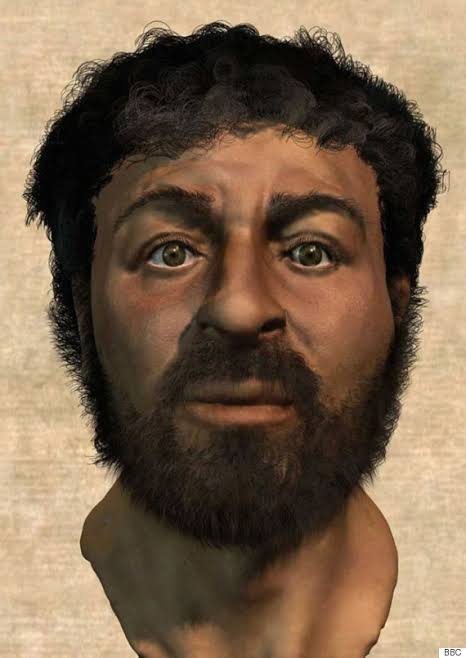
In 2001, forensic anthropologist Richard Neave created a three-dimensional model of a typical first-century man based on skulls discovered in the region. Although not a portrait of Jesus, this reconstruction represents the likely appearance of an average man from his community and stands in stark contrast to the Westernized image.
Embracing the Truth
Deconstructing the inaccurate European depiction of Jesus is not merely an exercise in historical precision; it is a crucial step toward theological integrity. Adhering to a historically inaccurate, racialized image restricts a comprehensive understanding of the Incarnation.
According to the biblical narrative, God did not enter the world as a member of the imperial elite or as someone resembling the Roman oppressors. Instead, Jesus is described as an ordinary, brown-skinned, Middle Eastern man—a refugee, a carpenter, and an outsider. Reclaiming the historical reality of Jesus removes centuries of cultural conditioning and allows for a renewed understanding of a Savior who identified with the marginalized and participated in the diverse, global human experience.